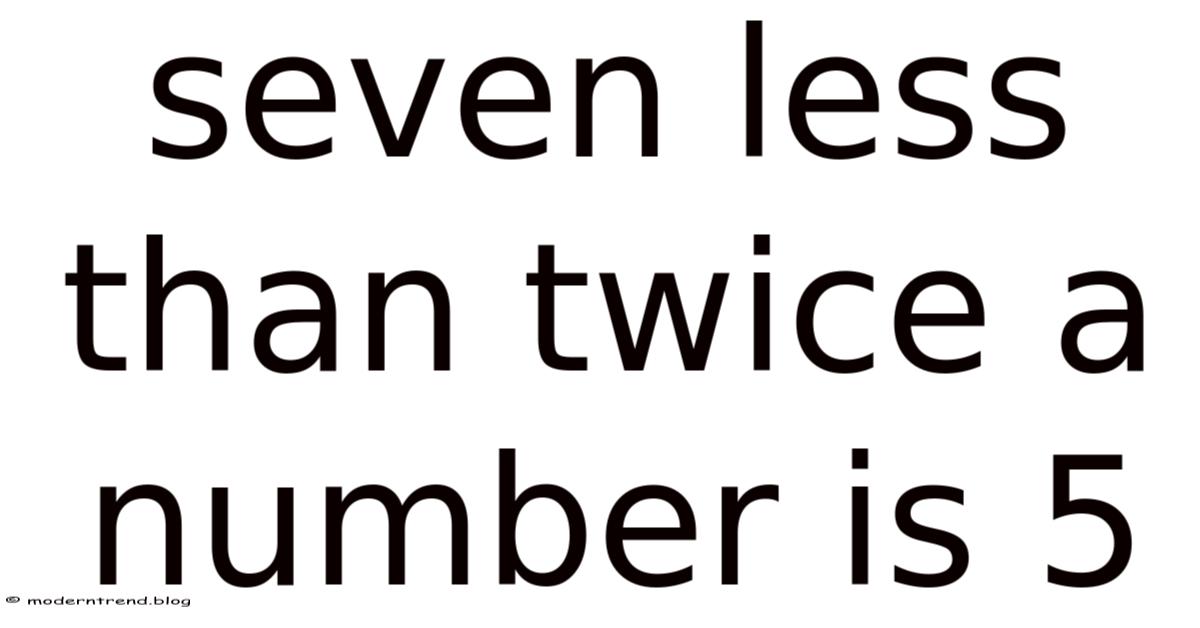
Seven Less Than Twice a Number Is 5: Your Complete Guide to Solving This Classic Algebra Problem
Let me ask you something. Even so, when was the last time you actually enjoyed solving a word problem in algebra? Chances are, if you're like most people, your answer is "never" or maybe "only when I absolutely had to.Because of that, " But here's the thing – problems like "seven less than twice a number is 5" aren't just random exercises that teachers throw at us to make us suffer. They're actually doorways to understanding how math describes the world around us Not complicated — just consistent..
I know what you're thinking: "Great, another math post. How is this going to help me?" Well, grab a coffee (or tea, or whatever gets you through algebra) because by the end of this article, you won't just know how to solve this specific problem – you'll understand why it matters and how to tackle dozens of similar ones with confidence.
What Is "Seven Less Than Twice a Number Is 5"?
At its core, this phrase is a word problem that translates directly into an algebraic equation. Let's break it down piece by piece, because honestly, this is where most people get tripped up.
When we say "a number," we're talking about an unknown value – something we need to find. In real terms, in algebra, we represent unknowns with letters, usually x. So "a number" becomes x.
"Twice a number" means two times that number. That's straightforward enough: 2x Small thing, real impact..
"Seven less than twice a number" is where things get interesting. And it means we take twice the number and subtract seven from it. Here's the thing — this doesn't mean seven minus twice a number. So we get 2x - 7 It's one of those things that adds up..
"Is 5" tells us what this expression equals. In algebra, "is" translates to the equals sign. So we end up with 2x - 7 = 5.
That's it. The entire phrase becomes a simple linear equation: 2x - 7 = 5.
But here's what most people miss – understanding why the translation works this way. When you say "seven less than twice a number," you're describing a process: first, double the number; second, take away seven. The order matters, and that's crucial for setting up equations correctly Easy to understand, harder to ignore..
Why We Don't Always Get It Right the First Time
I've watched countless students struggle with this exact translation, and it usually comes down to one thing: the difference between "seven less than twice a number" and "twice a number less seven." They sound similar, but they mean different things.
"Seven less than twice a number" = 2x - 7 (we subtract seven from twice the number)
"Twice a number less seven" = 2(x - 7) = 2x - 14 (we subtract seven from the number first, then double it)
See how that works? The order of operations matters, and English can be surprisingly tricky when it comes to mathematical expressions.
Why This Matters Beyond the Classroom
Here's where I'm going to get a bit philosophical on you: understanding how to translate word problems into equations is one of those skills that seems abstract until you actually need it in real life. Then suddenly, it's incredibly practical That's the part that actually makes a difference..
Think about it. When a car salesman tells you "the discount is seven less than twice the market value," you're working with the same concept. Here's the thing — when you're shopping and see a sign saying "7 less than twice the original price is now $5," you're doing the same mental math. Even when you're budgeting and figuring out how much you need to earn to cover expenses after taxes, you're essentially solving equations like this one.
But beyond the practical applications, mastering these translations builds something more valuable: mathematical thinking. Here's the thing — it trains you to break down complex situations into manageable parts, to recognize patterns, and to solve problems systematically. These aren't just math skills – they're life skills.
I remember working with a client who was running a small bakery. Here's the thing — she kept saying, "I need to figure out how many loaves I need to sell to break even. " What she was really asking was: "If I sell loaves at $5 each and my costs are $7 less than twice the number of loaves, how many do I need to sell to make $0 profit?" She just didn't know the algebraic language to express it.
How to Solve 2x - 7 = 5 Step by Step
Alright, let's get into the meat of things. On the flip side, you want to solve 2x - 7 = 5. Here's how I'd walk through it, step by painful but necessary step.
Step 1: Isolate the Variable Term
Our goal is to get x by itself on one side of the equation. Right now, we have 2x minus 7 equals 5. Also, to isolate 2x, we need to get rid of that -7. That's why how do we do that? By doing the opposite – we add 7 to both sides Not complicated — just consistent..
2x - 7 + 7 = 5 + 7
This simplifies to:
2x = 12
Step 2: Solve for x
Now we have 2x = 12. To get x alone, we divide both sides by 2.
2x ÷ 2 = 12 ÷ 2
Which gives us:
x = 6
Step 3: Check Your Work
This is the step most people skip, and honestly, it's a mistake. Always check your answer by plugging it back into the original equation No workaround needed..
Original equation: 2x - 7 = 5
Substitute x = 6: 2(6) - 7 = 5
Calculate: 12 - 7 = 5
And indeed, 5 = 5. Perfect!
So x = 6 is our solution.
The Bigger Picture: Why These Steps Work
###The Bigger Picture: Why These Steps Work
At its core, solving an equation is an exercise in maintaining balance. The equal sign is not a command to “do something to the left side”; it is a statement that the two expressions have identical value. Because of that, any operation we perform on one side must be mirrored on the other, or the equality breaks.
When we added 7 to both sides, we were applying the additive inverse of –7. Adding 7 cancels the subtraction, leaving the term 2x untouched on the left while simultaneously increasing the right‑hand side by the same amount. This is justified by the addition property of equality: if a = b, then a + c = b + c for any real number c Worth keeping that in mind..
The subsequent division by 2 relies on the multiplicative inverse of 2. Multiplying (or dividing) both sides by the same non‑zero number preserves equality, a direct consequence of the multiplication property of equality. In essence, we are undoing the multiplication that originally linked x to the coefficient 2, thereby isolating the variable.
These properties are not arbitrary tricks; they are foundational axioms of the real number system. Recognizing them transforms the mechanical process of “moving numbers across the equals sign” into a logical deduction grounded in why the steps are valid Small thing, real impact..
Common Pitfalls and How to Avoid Them
-
Forgetting to Apply the Operation to Both Sides
It’s tempting to “move” the –7 by simply erasing it, but that neglects the right side. Always write the operation explicitly on both sides to keep the balance clear. -
Dividing by Zero or an Expression That Could Be Zero
Before dividing, verify that the divisor is non‑zero. In this case, 2 is a constant, so it’s safe. When the divisor contains a variable, consider separate cases or note restrictions And that's really what it comes down to. And it works.. -
Sign Errors When Transferring Terms
A minus sign in front of a term becomes a plus when moved across the equals sign, and vice versa. Double‑check each sign change; a single slip can flip the solution Practical, not theoretical.. -
Neglecting the Check
Substituting the solution back into the original equation catches arithmetic slips and confirms that no extraneous roots were introduced—especially important when squaring both sides or clearing denominators.
Translating Word Problems: A Quick Checklist
- Identify the unknown and assign it a variable (usually x).
- Parse the language for key phrases: “less than” signals subtraction, “twice” signals multiplication by 2, “is” often translates to “=”.
- Write the expression exactly as the words dictate, respecting the order of operations.
- Form the equation by setting the expression equal to the given quantity.
- Solve using inverse operations, applying the properties of equality each step.
- Interpret the solution in the context of the problem (e.g., a negative number of loaves makes no sense, prompting a re‑examine of the model).
Applying this checklist to the bakery example:
- Unknown: number of loaves = x.
- “Twice the number of loaves” → 2x.
- “Seven less than twice the number of loaves” → 2x – 7.
Consider this: - “How many do I need to sell to make $0 profit? ” → revenue (5x) equals cost (2x – 7). - Equation: 5x = 2x – 7 → 3x = –7 → x = –7/3, which signals that the original phrasing needed adjustment (perhaps the cost was meant to be subtracted from revenue). The exercise shows how translating correctly prevents nonsensical answers.
Conclusion
Mastering the translation from words to symbols and the systematic application of inverse operations does more than yield a correct value for x; it cultivates a disciplined way of thinking. Day to day, by recognizing that equality is a relationship that must be preserved, we learn to dissect complex situations, isolate essential components, and rebuild solutions with confidence. Whether balancing a bakery’s books, calculating a discount, or planning a budget, the same logical steps guide us from confusion to clarity. Embrace these tools, and you’ll find that the language of mathematics becomes a powerful ally in everyday decision‑making Surprisingly effective..
