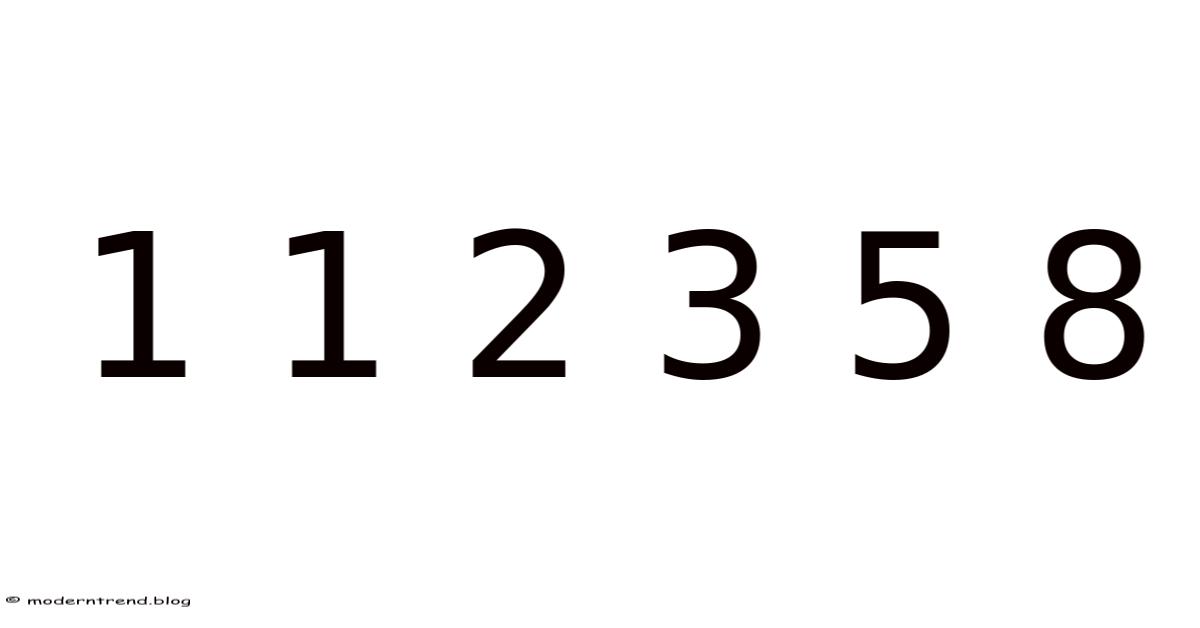
Ever seen a rabbit population, a sunflower seed head, or a seashell and wondered why it looks so… perfect? The answer is a little number line that starts with two ones and keeps adding the last two numbers together: 1, 1, 2, 3, 5, 8, 13, 21… It’s the Fibonacci sequence, the mathematical pattern that shows up everywhere from art to nature It's one of those things that adds up. No workaround needed..
What Is 1 1 2 3 5 8
The moment you look at the first six terms—1, 1, 2, 3, 5, 8—you’re staring at the building blocks of a sequence that grows by adding the two preceding numbers. It’s simple, yet it’s the foundation of a whole family of numbers that mathematicians call Fibonacci numbers. The sequence was first described in the 13th‑century Indian mathematician Leonardo of Pisa, who later became known as Fibonacci. He introduced it to the Western world in his book Liber Abaci Worth knowing..
You'll probably want to bookmark this section It's one of those things that adds up..
The rule is easy:
Start with 1, 1. Then each new number equals the sum of the two before it.
So after 5 comes 8 (5 + 3), after 8 comes 13 (8 + 5), and so on It's one of those things that adds up. But it adds up..
You might think it’s just a quirky pattern, but the sequence actually appears in the way leaves grow on a stem, the arrangement of petals in a flower, the branching of trees, and even the orbits of planets. In practice, it’s a hidden language of growth and balance.
Why It Matters / Why People Care
You’re probably wondering, “Why should I care about a sequence that starts with 1, 1, 2, 3, 5, 8?” The answer is that the Fibonacci sequence is a shortcut to understanding complex systems.
- Nature’s Blueprint: The spiral of a nautilus shell follows the golden ratio, which is the limit of successive Fibonacci ratios (8/5 ≈ 1.6, 13/8 ≈ 1.625, etc.). That ratio shows up in the proportions of the human body and the layout of the cosmos.
- Financial Markets: Traders use Fibonacci retracement levels (23.6%, 38.2%, 50%, 61.8%) to predict price movements. It’s a way to apply a natural pattern to human behavior.
- Art and Architecture: The Parthenon, the Starry Night, and even modern logos use Fibonacci ratios to create visual harmony.
- Algorithms: Fibonacci numbers appear in recursive algorithms, dynamic programming, and data structures like heaps and priority queues.
When you understand the sequence, you get a lens to see patterns in the world that would otherwise look random. It’s a bridge between math and the messy reality of life.
How It Works (or How to Do It)
1. The Basic Rule
Start with 1, 1.
Add the last two numbers to get the next one.
Repeat.
That’s it.
2. The Golden Ratio Connection
If you take any two consecutive Fibonacci numbers and divide the larger by the smaller, you get a number that gets closer and closer to 1.618—known as the golden ratio (φ).
For example:
- 8 ÷ 5 = 1.Think about it: 6
- 13 ÷ 8 = 1. 625
- 21 ÷ 13 = 1.
This changes depending on context. Keep that in mind.
This ratio is the key to why the sequence feels “right” to our eyes and ears.
3. Recursive vs. Iterative Generation
-
Recursive:
def fib(n):
    if n <= 1:
        return n
    return fib(n-1) + fib(n-2)
It’s elegant but slow for large n because it recalculates values many times That's the part that actually makes a difference..
-
Iterative:
def fib_iter(n):
    a, b = 0, 1
    for _ in range(n):
        a, b = b, a + b
    return a
This runs in linear time and is the practical choice.
4. Applications in Design
- Rule of Thirds: Divide a canvas into a 3×3 grid. Place key elements along the lines or intersections. The Fibonacci grid is a variation that uses the ratio to create a spiral.
- Photography: Position the subject along the golden spiral to create a natural focal point.
5. In Programming
- Dynamic Programming: Store previous results in an array or memoization dictionary to avoid redundant calculations.
- Data Structures: Fibonacci heaps use the sequence to maintain a low amortized cost for operations like decrease-key.
Common Mistakes / What Most People Get Wrong
- Thinking it’s just a “fun” sequence
It’s more than a math trick; it’s a model for growth. - Using the wrong starting numbers
Some people start with 0, 1, which shifts the whole sequence. - Assuming every pattern is Fibonacci
Nature is noisy. Not every spiral is perfectly golden. - Over‑optimizing recursive code
Without memoization, a simple recursive Fibonacci explodes in time. - Misinterpreting the golden ratio
It’s a limit, not a fixed ratio for every pair of numbers.
Practical Tips / What Actually Works
- Quick Fibonacci Generator
If you need the first 20 numbers, just write a loop in any language.
Memorize the First Few Numbers
Having the first 10 or so numbers memorized can help you recognize the pattern in unexpected places.
-
Use the Closed-Form Expression
Binet's formula allows you to calculate the nth Fibonacci number directly, without iteration:
$ F(n) = \frac{\phi^n - (-\phi)^{-n}}{\sqrt{5}} $ where $\phi$ (phi) is the golden ratio Most people skip this — try not to.. -
Apply the Sequence Thoughtfully
Use the Fibonacci sequence and golden ratio as guidelines, not rigid rules. They can enhance design and code, but don't force them where they don't fit. -
Explore Advanced Data Structures
If you're interested in computer science, study Fibonacci heaps and how they use the sequence to optimize certain operations That's the whole idea..
Conclusion
The Fibonacci sequence is more than a mathematical curiosity; it's a fundamental pattern that appears in nature, art, and technology. By understanding its basic rule, connection to the golden ratio, and applications in various fields, you can appreciate its elegance and power. Whether you're a programmer optimizing algorithms, a designer composing a layout, or simply a curious observer of the world, the Fibonacci sequence offers a lens to see the underlying order in apparent chaos. Remember to use it as a tool, not a rule, and always consider the context. With these insights, you can harness the beauty and efficiency of the Fibonacci sequence in your own work and life.
Beyond the Basics
- Higher‑order recurrences
Variants such as the Tribonacci or Padovan sequences replace the simple sum of two predecessors with sums of more terms. These can model different biological or economic growth patterns. - Probabilistic Fibonacci
In stochastic models, the recurrence can be driven by random variables, yielding distributions that resemble the Fibonacci structure in expectation. - Quantum and Information Theory
Certain quantum circuits exploit Fibonacci anyons for topological quantum computation, where the braid group representations follow Fibonacci fusion rules.
Practical Takeaway
- Identify the Pattern – Look for additive relationships in data; a quick check of successive ratios can reveal a hidden Fibonacci structure.
- make use of the Ratio – When designing, use the golden ratio as a soft guide rather than a hard constraint; it often yields pleasing proportions but must adapt to context.
- Optimize with Memoization – In programming, always cache intermediate results; the same principle that keeps the sequence efficient in nature applies to algorithms.
- Explore Variants – Don’t stop at Fibonacci; experiment with its cousins to fit specific problems or artistic visions.
Final Thoughts
The Fibonacci sequence is more than an elegant mathematical curiosity; it is a bridge between abstract number theory and tangible reality. From the spiraling shells of mollusks to the branching of trees, from the layout of a poster to the efficiency of a priority queue, the sequence appears wherever growth, balance, and optimality intersect. Recognizing its presence equips you with a powerful lens: a lens that turns the seemingly chaotic into the harmonious, the complex into the comprehensible That's the part that actually makes a difference..
This changes depending on context. Keep that in mind.
Whether you are a mathematician, a designer, a coder, or simply a curious mind, the Fibonacci sequence invites you to explore patterns that recur across time and space. Embrace it as a tool—one that can sharpen your intuition, improve your work, and deepen your appreciation for the subtle order that underlies the world around us.
